

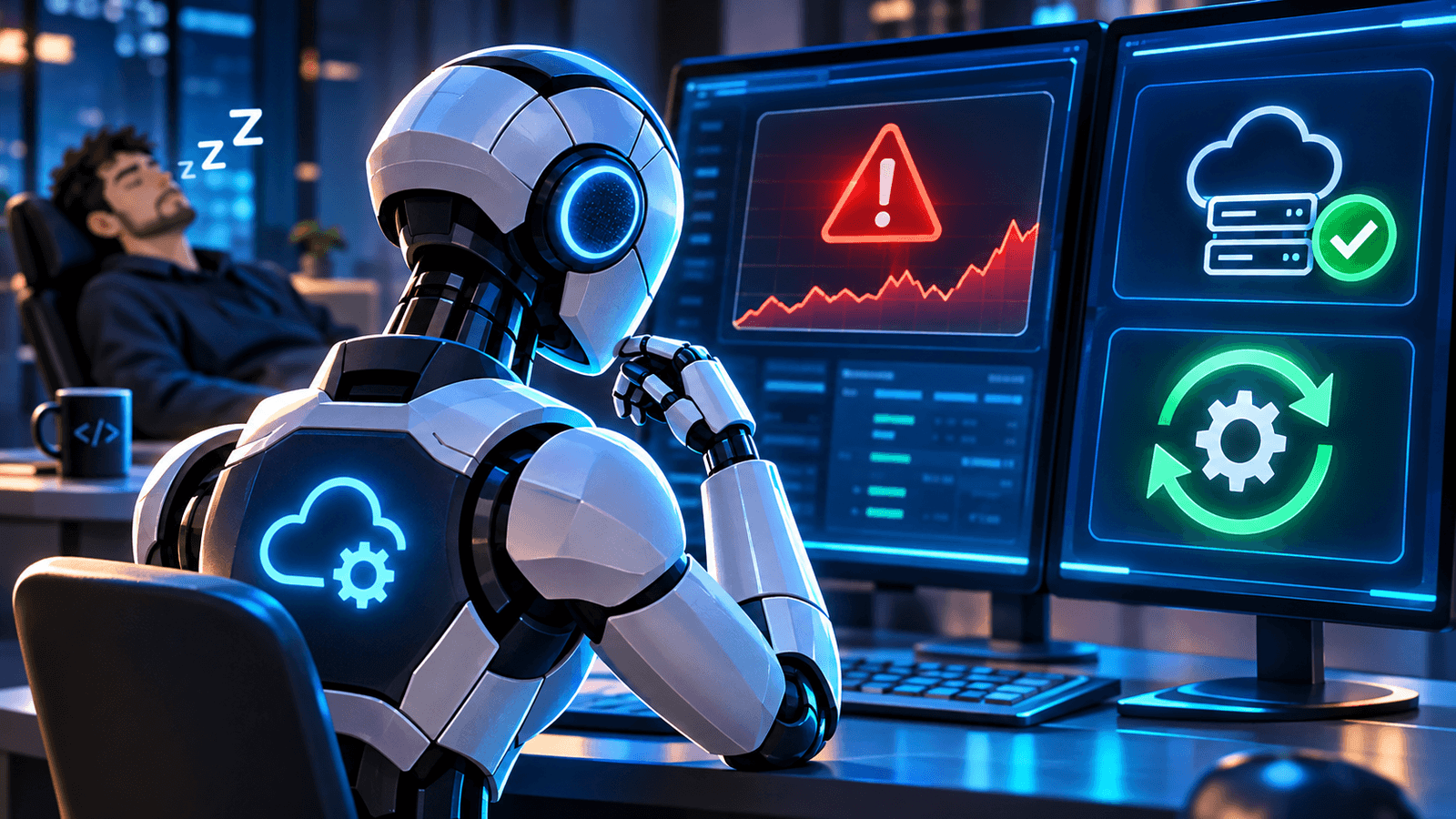
At 2:13 in the morning, a payment service starts to drag. Errors pop up across different regions. The dashboards light up, throwing warnings everywhere. A few years back, this would’ve set off a bunch of alerts and woken up the whole operations team.
Not anymore.
Now, an autonomous incident response agent catches the weird latency before most engineers even see it coming. It scans logs across all services, spots a memory leak in a newly deployed container, reroutes traffic away from the bad instances, files an incident report, and starts pulling diagnostics all on its own.
For several minutes, no one lays a hand on the system. Things settle down. Users barely notice a thing.
This is where modern infrastructure’s headed. AI isn’t just helping people write code or chase after bugs in documentation. It’s pushing into the heart of engineering production reliability.
Pitching the idea of AI Site Reliability Engineers used to sound ridiculous. Now, it feels pretty close to real. But there’s a difference between assisting during incidents and actually running them solo. That’s the real divide and where the real debate starts.
Site Reliability Engineering Has Always Been About Decision Making
SRE isn’t just about watching dashboards or restarting crashed services. The real job? It’s judgment.
Production systems rarely fail neatly. One small issue can ripple through databases, APIs, queues, caches, and everything else. Engineers react by putting together scraps of information, under pressure, trying not to make things even worse.
Everything depends on context.
The seasoned SRE knows which alerts demand instant action, which can wait, which systems tend to break, which dependencies are shaky, and which fixes might cause bigger headaches during peak hours.
Classic automation never managed to replace that judgment. It followed instructions, full stop.
AI agents broke that mold.
Instead of sticking to static scripts, they look for patterns, connect the dots, generate responses, and at times, make operational calls themselves.
That’s a big shift. It turns automation from a helper into a decision maker.
From Monitoring Systems to Autonomous Systems
Practically every infrastructure team uses automation these days. Apps deploy automatically. Scaling policies kick in when traffic jumps. Monitoring trips alerts using preset rules. Recovery scripts restart sick services without anyone lifting a finger.
But these tools stick to their lane. They’re just executing steps.
AI-driven reliability systems are different. They try to understand what’s going on.
AI agents now read logs, summarize incidents, spot anomalies, flag weird traffic, and recommend next moves. Some are even patching systems on the fly, isolating workloads, tweaking configurations, or rolling back deployments all on their own.
This builds a new layer between the infrastructure and the humans behind it.
Instead of jumping straight into telemetry, engineers let the AI do the first round of interpretation.
For a small setup, this seems smart. At production scale? Things get tricky, fast.
Incidents Are Never Like Training Data
A common myth around autonomous ops is that failures repeat enough for AIs to handle them.
Sure, some do. A container crashes. CPU surges. A buggy deployment takes things down. AI can spot these and act.
But the tougher ones are messy.
A partial outage in a dependency spirals into slowdowns everywhere. A traffic bump clashes with a forgotten config tweak from weeks ago. Retry loops drown internal APIs while monitoring says everything’s fine.
These situations morph in real time.
Seasoned engineers draw on intuition past failures, how the company works, system architecture, informal stories that never make it to the docs.
AI agents don’t have that kind of gut feel. They stick to what’s observable, what’s happened before, and probability.
That works until the system does something genuinely new.
And in production? That happens all the time.
Hidden Risks in Autonomous Recovery
A big selling point for AI-powered incident response is how invisible it becomes when it’s working well.
If autonomous agents fix things fast, people stop noticing just how often things are going off the rails behind the curtain.
The system seems solid.
But invisible fixes hide a different risk.
An AI agent might keep patching over symptoms, restarting crashed services during heavy traffic, for example, without seeing the real underlying problem. The outages go away so quickly that nobody digs deeper. Then, weeks later, a hidden resource drain blows up into a full-blown production disaster.
Automation technically “succeeded” over and over until it failed once, big.
That breeds overconfidence.
True reliability isn’t just fast recovery. It’s knowing why things break at all.
Quick fixes without real understanding quietly make systems weaker.
Partial Context is a Big Deal
AI agents work great when the environment is open and structured.
Real infrastructure isn’t like that.
Metrics might lag. Logs can be missing. Dependencies sometimes go dark. Even monitoring tools might drop the ball during outages.
Humans work around missing info with reasoning and experience. They ask questions dashboards can’t answer.
Did this start after yesterday’s networking change? Why’s traffic odd only in one region? Is this connected to that old storage bug?
AI struggles when vital context isn’t in the data.
It can munch through loads of telemetry, but speed isn’t the same as insight.
Sometimes, the visible data is flat out misleading. Engineers learn to question everything.
That level of skepticism? Machines aren’t great at it.
AI Makes Failure Faster
Something else is shifting, quietly, in these teams.
AI speeds up detection. Analysis is quicker. Mitigation goes faster.
But speeding things up means mistakes travel faster, too.
A human screwing up a rollback might mess up one environment slowly, giving others a chance to catch it. An AI system can cascade a wrong change through production almost instantly.
The blast radius is huge.
This matters a lot in big, interconnected cloud setups where orchestration tools run huge swaths of infrastructure all at once.
A bad AI decision won’t stay isolated. It can ripple through clusters, services, deployment tools, and networks in minutes.
The same automation that makes things resilient can, if it’s wrong, make things unstable fast.
Humans Are Still the Safety Net
People talk like AI ops will replace all SRE teams.
Can autonomous systems run everything alone?
In reality, it’s not about replacement it’s about making humans more effective.
AI kills noise, cuts down alert fatigue, speeds up diagnostics, connects dots people miss, and automates fixes. That’s a ton of value.
But reliability isn’t just execution.
It’s weighing risks, balancing business priorities, making architectural calls, communicating through crisis, and shaping long term strategy.
AI might know how to restore service fast. Human engineers decide whether jumping back online right away could cause bigger headaches.
That distinction isn’t small.
Production systems aren’t sealed off from business needs, customer promises, legal stuff, or cost.
Human judgment is still at the core.
Observability is About Trust Now
With AI agents stepping in, observability isn’t just for debugging.
It becomes about trust.
Teams need visibility not only into how their infrastructure acts but into how their AI makes decisions.
Why did it roll back here? Why did it skip that alert? Why reroute traffic now?
If you can’t explain what an autonomous system did especially under pressure it’s tough to trust it.
Now, ops teams need to monitor both their systems and the AI controls sitting on top.
That adds a new layer of complexity to the whole reliability puzzle.
The SRE Role is Evolving
SREs aren’t scrambling to fix every outage anymore. More and more, they’re watching over systems that act on their own. Their job is shifting from hands-on fixes to designing boundaries, policies, vetting automations, and seeing bigger risks.
SRE work gets more strategic.
The best engineers won’t just manage servers or alerts. They’ll shape autonomous systems that run production while they sleep.
It needs a new mindset.
Reliability becomes less about firefighting and more about designing smart, trustworthy operations that scale.
Final Thoughts
AI Site Reliability Engineers aren’t sci-fi. They’re already hands-on across deployment, monitoring, incident response, and cloud management.
They offer real wins: Faster detection, quicker recovery, lighter workloads, sharper analysis.
But speed isn’t everything.
True reliability is about understanding systems deeply, so you know when automation gets risky.
AI agents handle tons of operations well. Some incidents hardly need people at all anymore.
The question isn’t if autonomous systems can act; it’s whether they can understand enough to act safely when the playbook runs out.
That’ll shape the future of reliability engineering more than automation itself.

Frequently Asked Questions
1. Can AI SRE agents really resolve production incidents without humans?
2. What's the biggest danger of autonomous incident response?
3. Will AI eventually replace human Site Reliability Engineers?

Sannan Ali is a Computer Science student specializing in DevOps, with a strong focus on building reliable, scalable, and automated systems. His work centers on modern infrastructure practices, CI/CD pipelines, and system reliability, along with a growing interest in AI-driven automation. He also has experience in frontend and backend development, giving him a practical understanding of complete software systems. He writes about DevOps, AI in engineering, and real-world challenges in modern software development.